


Retail media networks operate by combining first-party shopper data, ad inventory across a retailer’s digital and physical properties, and reporting tools that tie ad exposure to verified point-of-sale transactions. They give brands a way to target high-intent shoppers and give retailers a new revenue stream built on data and ad operations.
Retail media has grown quickly. According to eMarketer, US retail media ad spend is on track to reach $109.40 billion by 2027, making it one of the fastest-growing digital channels. For IT teams and commerce analysts, understanding how these systems work is important because retail media relies on several connected components: systems that recognize logged-in shoppers, event pipelines that collect browsing and purchase activity, and reporting tools that match ad impressions to actual sales.
Key takeaways:
- Retail media networks use first-party shopper data and retailer-owned ad inventory to reach high-intent shoppers and tie ad exposure to verified sales.
- Retailers gain high-margin revenue and deeper shopper insight, while brands get authenticated targeting and SKU-level performance reporting.
- Effective retail media depends on connected systems, such as identity graphs, event pipelines, clean rooms, ad servers, and attribution engines, that plug into existing tech stacks.
- Retail media now spans onsite, offsite, CTV, and in-store formats, raising the bar for data governance and cross-channel measurement.
- As more retailers launch networks, advertisers need a clear framework for choosing partners based on governance, integration options, reporting depth, and audience quality.
This guide explains how retail media networks collect and activate data, how ads are served across channels, and how sales results are measured in a verifiable way.
- What are retail media networks (RMNs)?
- Why retail media networks are growing
- How retail media networks work
- Key benefits for each stakeholder
- Types of retail media
- Retail media landscape: Key players and platforms
- Challenges and considerations in the retail media network industry
- Future trends in retail media
- Frequently asked questions
What are retail media networks (RMNs)?
A retail media network is an advertising platform run by a retailer that uses its own customer and transaction data to sell ads to brands. The retailer uses loyalty data, past purchases, and product catalog information to decide which ads to show on its properties and partner channels.
Retail media can show up in many places where a shopper interacts with a retailer. That includes ecommerce sites, mobile apps, email campaigns, streaming or CTV apps, in-store screens, and partner environments, such as social platforms or digital billboards.
These networks are not limited to one retailer type. Examples include:
- Digital-first operators such as Amazon Ads
- Marketplaces such as eBay
- Mass merchants such as Walmart and Costco
- Grocers such as Kroger
- Department stores such as Macy’s
- Category specialists such as The Home Depot
- Delivery and quick-commerce players such as Instacart
Retail media is also moving beyond single retailers. Amazon, for example, has launched a Retail Ad Service that lets other retailers use its ad technology, so its media tools can power networks on third-party sites as well.
Why retail media networks are growing
Retail media networks are growing because they give advertisers something that open web channels struggle to deliver: logged-in users, rich purchase history, and direct proof that an ad led to a sale.
Platform-level numbers show the same trend. WARC estimates that Amazon’s retail media ad revenue alone is set to exceed $60 billion this year, with Amazon accounting for more than half (53.6%) of global retail media spend outside China.
Retailers are also investing heavily in new capabilities, which keeps the channel growing:
- Target’s Roundel now generates nearly $2 billion in value for the company and is rolling out new tools, data products such as Precision Plus, and in-store expansion to support more than 2,000 brand partners.
- Walmart Connect is adding APIs for display ads, expanding in-store and off-site inventory, and opening to more international and non-endemic advertisers.
- Walmart has also acquired TV maker Vizio to extend its advertising reach into smart TVs, making retail media part of its connected TV strategy.
This growth translates into more demand for integrations with identity systems, event pipelines, and clean rooms, since retail media only works at scale when those components are in place and aligned with privacy and governance requirements.
How retail media networks work
Retail media networks work by combining shopper identity data, ad inventory, and sales reporting systems to deliver targeted ads and confirm which impressions led to real purchases. They function through a connected set of data pipelines and tools that retailers and brands use to build audiences, deliver ads, and measure results.
The overview below explains how each component fits together.
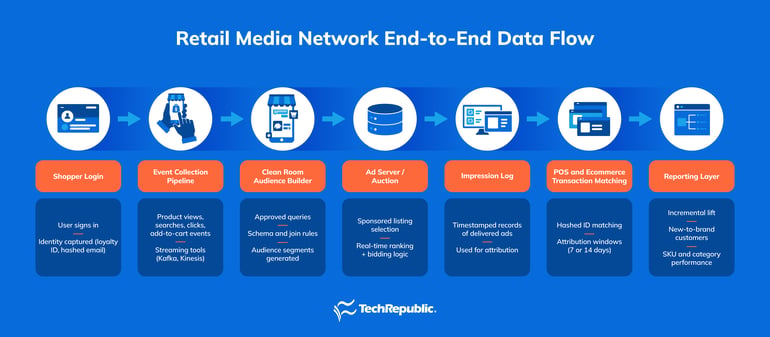
The retailer’s side: Data, inventory, and infrastructure
Retailers supply the data and systems that make retail media possible. Their shopper data, owned inventory, and backend infrastructure work together so advertisers can reach logged-in customers, run campaigns efficiently, and measure the outcomes with confidence.
Identity and behavioral data
Retailers begin with the information they already hold: loyalty IDs, hashed emails, past purchases, and browsing behavior. These signals help identify who the shopper is and what they’ve shown interest in.
Most enterprise retail media networks now standardize these signals using event taxonomies so that every click, view, and search follows a consistent structure. Clean rooms then apply schema rules to keep data aligned across all brand partners.
Ad inventory
This identity layer works hand in hand with the retailer’s ad placements. Retailers control where ads appear — sponsored products, search results, category-page display units, and native placements on product pages. Many also extend this inventory off-site through social platforms, video partners, or connected TV, letting advertisers reach shoppers even when they’re not on the retailer’s site.
Infrastructure
Identity and inventory are supported by the retailer’s technical foundation. Retailers maintain:
- Identity graphs that connect logins, devices, and purchase records
- Real-time bidding engines that rank and select ad placements
- ETL pipelines that process impression logs and sales data (ETL pipelines are data-processing systems that move information from one place to another so it can be cleaned, organized, and made ready for reporting or analysis)
- Clean rooms make sure every brand and the retailer uses the same data structure and field names, so the data lines up correctly and can be joined without errors. When retailers and brands work together inside a clean room, both sides need to use the same “labels” and data structure. “Schema rules” just means the clean room forces everyone to use the same format for data (e.g., the same names for fields — product_id, not productID or SKU)
Many retail media networks now enforce “query governance policies” — rules that define allowed joins, limit row-level exports, and set mandatory data retention periods. These guardrails prevent misuse of granular data and strengthen shopper privacy protection.
Retailer infrastructure components
Below is a simple overview of the key technical components retailers rely on and how each one contributes to ad delivery and reporting.
| Identity graph | Matches users across logins and devices | Uses deterministic and probabilistic stitching |
| Event pipeline | Captures browsing and shopping activity | Tracks product views, searches, and cart events |
| Clean room | Controls data access | Enforces schema, joins, auditing, retention limits |
| Ad server | Places sponsored content | Uses auction logic and relevance ranking |
| Attribution engine | Connects impressions to sales | Matches to POS and ecommerce transaction logs |
The brand’s side: targeting, bidding, and measurement
Advertisers use retail media networks to build audiences, place ads, and measure results, all based on retailer-provided data.
Brands typically rely on RMNs to:
- Build audiences using recency, purchase frequency, and SKU affinity
- Launch sponsored product and keyword campaigns
- Track new-to-brand sales, ROAS, and category lift
Many enterprise brands establish “PDP readiness gates” before they start spending. These gates ensure that product detail pages meet specific quality standards (image resolution, structured attributes, clear titles). Retail media networks tend to reward well-optimized PDPs with better ad placement and higher conversion rates.
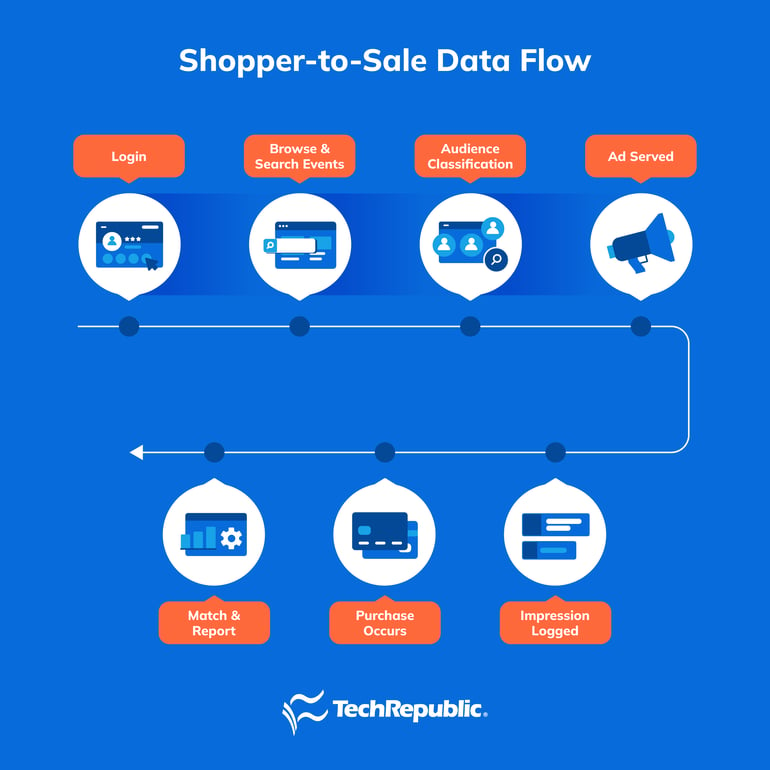
The data flow: from shopper to verified sale
Retail media performance depends on a set of connected steps that link shopper actions to final purchases:
- User signs in: The shopper logs in, creating a persistent identity connected to loyalty data.
- Event collection: Browsing actions — searches, clicks, and views — are captured by an event pipeline.
- Audience creation: Clean rooms run approved SQL queries that determine which shoppers qualify for a campaign.
- Ad delivery: The ad server selects which sponsored product or display ad to show based on bid, relevance, and expected conversion.
- Conversion matching: The system matches ad impressions to purchases using hashed identifiers and attribution windows, such as seven or 14 days.
- Reporting: Dashboards show incremental lift, new-to-brand shoppers, SKU-level movement, and category performance.
Key benefits for each stakeholder
Retail media networks create value on both sides of the table. Retailers gain a high-margin revenue stream and sharper insight into shopper behavior, while brands get better targeting and clearer proof that ads are driving sales.
For retailers
Retail media is attractive because the margins are far higher than core retail. A 2024 Oliver Wyman analysis estimates profit margins of about 30% for off-site retail media and up to 80% for on-site retail media, making it a major profit driver for large retailers.
- High-margin revenue from on-site and off-site ad inventory
- Better visibility into category trends and shopper intent
- Ability to improve loyalty programs with more relevant, data-backed offers
For brands
Brands are leaning into retail media because it is becoming a core budget line, not an experiment. A 2024 Quartile Retail Media Pulse report found that 99% of marketers plan to maintain or increase their retail media budgets.
Brands are leaning into retail media because it is now a core budget line, not an experiment. In its H1 2024 retail media report with LiveRamp, eMarketer estimated that US omnichannel retail media ad spend for 2024 would be about $54.85 billion, a 26% year-over-year increase.
- Authenticated targeting based on logged-in users and real purchase history
- Access to SKU-level and category-level reporting, including new-to-brand metrics
- Ability to adjust spend based on verified sales impact rather than just clicks or modeled conversions
Types of retail media
Retail media spans several formats that line up with different points in the shopper journey. I list the types below, along with examples of each.
On-site retail media
- Sponsored product listings
- Search ads
- Display units on category and product pages
On-site placements reach high-intent shoppers who are actively browsing and comparing products on the retailer’s own properties.
Common on-site examples include:
- Amazon Sponsored Products, which appear in search results and on product detail pages inside Amazon’s shopping experience.
- Target Product Ads and search ads on Target.com and the Target app, offered through Roundel.
Off-site retail media
- Programmatic display
- Paid social
- Connected TV
In off-site campaigns, retailer data is used to build audiences on external channels, but reporting still flows back into the retail media network so measurement stays centralized.
Off-site examples include:
- Walmart Connect Offsite Media, which uses Walmart’s first-party data to reach audiences on CTV, display, video, mobile, audio, and native inventory through its DSP.
- Instacart Ads off-platform solutions, which let brands use Instacart’s shopper data to run ads on channels such as social media and TV while keeping closed-loop measurement.
Emerging formats
- In-store digital signage
- Retailer CTV channels
- Store-level targeting tied to anonymized location signals
These newer formats extend retail media into physical stores and connected TV environments. Verification often relies on loyalty redemptions, store traffic data, and controlled store tests to prove impact.
Emerging-format examples include:
- Target’s Roundel in-store experiences, where Target is testing demos, sampling, and digital screens as part of its omnichannel media offering.
- Walmart Connect’s in-store and CTV capabilities, which layer in-store media and connected TV on top of onsite and offsite campaigns for brands.
Retail media format comparison
The table below gives a quick view of how each format differs in data needs, measurement, and operational complexity.
| On-site | Behavioral + SKU events | Direct sales matching | Low |
| Off-site | Identity graph + hashed IDs | Multi-channel logs | Medium |
| In-store | Traffic + loyalty/redemption | Incremental tests | High |
Retail media landscape: Key players and platforms
The retail media landscape includes retailer-owned networks and third-party platforms that help brands run campaigns across multiple retailers. Most enterprise teams work with a mix of both, depending on their budget, category, and technical requirements.
Major retailer-owned networks
Many large retailers operate their own media networks built on first-party shopper data and onsite inventory. Common examples include:
- Amazon Ads: Amazon offers sponsored products, streaming TV inventory through Prime Video, and off-site programmatic reach. It is the largest retail media network in the US.
- Walmart Connect: Walmart provides onsite search and display, in-store screens, and offsite programmatic via its DSP. It continues to expand internationally and into connected TV.
- Target Roundel: Roundel offers onsite ads, offsite media buying, CTV activations, and in-store digital experiences across Target’s nationwide footprint.
These networks differ in scale, data depth, and channel coverage, but all give advertisers access to logged-in shoppers and SKU-level measurement.
Third-party retail media platforms
Third-party platforms simplify buying across multiple retailers by providing a shared interface and common tools.
Examples include:
- Criteo: Provides a unified retail media platform connecting dozens of major retailers.
- CitrusAd: Operates a sponsored listing and display marketplace used by retailers such as Albertsons and Target.
- Instacart Ads: Offers sponsored products, display, and off-platform extensions for brands selling on Instacart’s marketplace.
These platforms help advertisers scale quickly without managing separate systems for every retailer.
Choosing the right retail media network
When evaluating which networks to invest in, IT, procurement, and analytics teams often follow a structured checklist to assess technical, operational, and measurement needs.
- Governance review: Confirm clean room rules, data retention limits, join permissions, and output restrictions.
- Audience depth: Validate which behavioral signals, SKU-level events, and category affinities are available.
- Integration mapping: Identify DSP compatibility, API availability, and how the platform connects with existing analytics stacks.
- Reporting granularity: Check how incrementality is calculated and whether new-to-brand, SKU movement, and category lift are included.
- Operational workflow: Review how quickly campaigns can be set up, how bidding works, and how approvals are handled.
- Margin math: Estimate profit after ads by analyzing retailer pricing, cost-per-click trends, and cost of goods.
Here is an evaluation framework. The table below outlines the core categories used in enterprise evaluations.
| Governance | Query restrictions | Are row-level outputs restricted? |
| Audience | Purchase depth | Are SKU events available? |
| Reporting | Incrementality | What methodology is used? |
| Integrations | DSP compatibility | Are APIs supported? |
Challenges and considerations in the retail media network industry
Retail media expansion comes with technical and operational challenges. These issues affect how long implementations take, how strict your compliance setup needs to be, and how much you can trust the numbers in your reports.
Data privacy and compliance
Retail media networks rely on identity graphs that connect logins, devices, and purchase history. That makes data governance a core requirement, not a nice-to-have.
Teams need to define:
- How user data is pseudonymized before it enters a clean room
- How deletion requests are handled across identity graphs and logs
- How long impression and transaction data can be stored
- How audits are run and who can approve queries
Clean rooms help by controlling access, but they still need strong rules. They must block row-level exports where possible, limit what fields can be joined, and enforce clear retention windows so sensitive data is not kept longer than needed.
Measurement and attribution
Measurement is one of the most debated areas in retail media. Buyers want to know whether an ad actually changed behavior or if the shopper would have purchased anyway.
Networks typically use one of two approaches:
- Holdout tests, where a control group does not see ads so their behavior can be compared to exposed users
- Modeled counterfactuals, where statistical models estimate what would have happened without exposure
Advertisers should ask how exposed and unexposed cohorts are built, how often tests are refreshed, and whether incrementality methods are consistent across categories and campaigns. Without clear answers, it becomes hard to compare performance across networks.
Competitive pressures
With most large retailers now running their own media networks, brands face overlapping audiences and different tools for each environment. This can fragment budgets and strain internal teams.
Enterprise advertisers often respond by:
- Narrowing their core network list to those with unique reach or better data
- Consolidating buying through third-party platforms where it makes sense
- Setting minimum reporting and integration standards before committing budget
The goal is to avoid spreading spend across too many networks that all reach the same shoppers with slightly different dashboards.
Common questions about retail media challenges
What makes data governance critical in retail media networks?
Retail media networks depend on identity graphs and transaction logs, so weak governance can lead to privacy issues, inaccurate joins, and unreliable reporting.
How can brands verify the accuracy of retail media measurement?
They should ask how incrementality is calculated, how exposed vs. unexposed cohorts are built, and whether the method is applied consistently across campaigns.
Why can working with too many retail media networks become a problem?
It can fragment budgets, create duplicate reach, and make it harder to compare reporting across platforms.
Future trends in retail media
Retail media continues to evolve quickly as retailers expand their data capabilities, add new channels, and integrate more advanced measurement tools. The trends below reflect where the industry is heading and what technical teams should expect to support over the next one to two years.
AI-driven ad ranking and personalization
Retailers are beginning to use AI models to improve how ads are ranked, priced, and personalized. Many networks now test models that predict which sponsored products are most likely to convert based on recent shopper behavior, product attributes, and real-time signals.
Retailers are also experimenting with:
- Automated keyword expansion
- AI-generated PDP content
- Real-time bid recommendations
These tools can increase revenue for retailers but may require new data flows and more frequent catalog updates for brands.
Connected TV becoming part of retail media
Connected TV is rapidly blending with retail media as retailers look for more ways to use their first-party data outside their own sites.
Examples include:
- Walmart integrating Vizio’s smart-TV footprint into Walmart Connect’s media offering
- Amazon using Prime Video ads alongside Amazon Ads targeting
- Kroger Precision Marketing activating shopper audiences in CTV through The Trade Desk
This trend will push IT teams to support CTV attribution, cross-device identity resolution, and additional reporting pipelines.
More in-store digital experiences
Retailers are investing in digital screens, shelf-edge displays, and other in-store media that rely on real-time data. These systems require coordination between store networks, identity systems, and attribution tools.
Common innovations include:
- Digital endcaps tied to loyalty IDs
- Smart carts or smart basket devices
- Computer vision tools for measuring in-aisle engagement
Measurement remains the biggest hurdle, so retailers are testing hybrid verification methods that combine loyalty redemption, store traffic models, and controlled store experiments.
Standardization of clean room governance
Clean rooms are expanding beyond “nice-to-have” and becoming the required foundation for any large retail media program. Retailers are moving toward:
- Standardized schemas
- Stricter join rules
- Shorter retention windows
- Multi-party computation tests
- Clearer audit procedures
This shift is driven by privacy expectations and buyer pressure for consistent, comparable reporting across networks.
Retail media integrating into the broader martech stack
Retail media is no longer managed in isolation. Brands increasingly want retail media data aligned with:
- Customer data platforms (CDPs)
- Marketing mix modeling (MMM)
- Unified identity graphs
- Commerce analytics systems
This means retailers must offer cleaner APIs, more granular export formats, and consistent field definitions so advertisers can integrate RMN reporting into their internal dashboards.
Global expansion and cross-border retail media
Large global chains, such as Carrefour, Tesco, Ahold Delhaize, and Woolworths, are growing their retail media businesses and adopting similar standards to US networks. As this expands, brands may need to plan:
- Cross-market reporting
- Shared clean room frameworks
- Global SKU taxonomy alignment
This also creates more demand for third-party platforms that can manage multiple countries and data rules from a single interface.
Frequently asked questions
What is retail media advertising?
Retail media advertising is the practice of running ads through a retail media network instead of the open web. Brands buy placements such as sponsored products, onsite search ads, display units, off-site programmatic ads, or CTV spots that are targeted using retailer data.
What are examples of retail media networks?
Common retail media networks examples include Amazon Ads, Walmart Connect, Target Roundel, Instacart Ads, Kroger Precision Marketing, Best Buy Ads, and The Home Depot’s Retail Media+ network. There are also multi-retailer platforms like Criteo and CitrusAd that provide tools and reporting across many retailers from a single interface.
What are the top retail media networks today?
The top retail media networks today, based on scale and advertiser adoption, typically include Amazon Ads, Walmart Connect, Target Roundel, Instacart Ads, and Kroger Precision Marketing, along with category-focused networks like Best Buy Ads for electronics and The Home Depot’s Retail Media+ for home improvement.
Why is retail media growing so quickly?
Retail media is growing quickly because it offers logged-in users, rich first-party data, and clear proof that ads led to sales. As third-party cookies fade and privacy rules tighten, brands need channels where they can still target precisely and measure performance reliably. Retail media networks also give retailers a high-margin revenue stream, so both sides have strong incentives to keep investing in this channel.