


Standard PS5 owners are getting a graphics feature previously associated with Sony’s more powerful PS5 Pro — without buying a new console.
The company announced Quick Spectral Super Resolution, or QSSR, on Oct. 1, a streamlined AI-assisted upscaling technology designed to run on the standard PS5. The technology aims to improve image clarity and stability despite the console lacking the dedicated machine-learning hardware found in the PS5 Pro.
PSSR analyzes game images pixel by pixel and uses AI to reconstruct them with more detail and stability than traditional upscaling methods. Sony developed QSSR as part of Project Amethyst, its AI graphics collaboration with AMD.
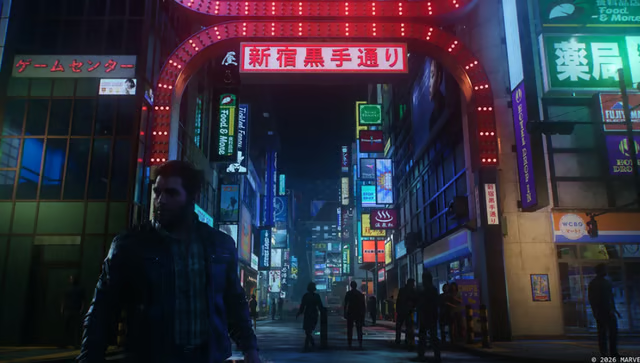
The AI-powered upscaling technology is designed specifically for the standard PS5 and will be available to PlayStation developers more broadly. Marvel’s Wolverine and Ghost of Yōtei are the first two games to support it, with both receiving patches that add QSSR as an optional graphics setting.
QSSR addresses the computational limitations that previously prevented Sony from bringing PSSR to the standard PS5.
How QSSR brings AI upscaling to PS5
Sony’s blog post announcement says the QSSR technology uses a streamlined neural network architecture and a hand-tuned implementation intended to get the most out of the standard PS5’s hardware.
That won’t mean regular PS5 owners will suddenly get PS5 Pro-level graphics. Still, Sony considers PSSR the “gold standard” for its AI upscaling technology on the PS5 Pro.
Early testing by Digital Foundry indicates that QSSR does not deliver the same performance as PSSR, in part because the standard PS5 lacks the PS5 Pro’s dedicated machine-learning silicon.
That hardware difference can also affect resolution targets. Digital Foundry’s testing suggests QSSR may be used with presentation targets closer to 1440p in some standard PS5 modes, rather than the 4K targets commonly used with PSSR on PS5 Pro.
Sony’s Daniel Craig stressed that developers can adjust both rendering resolution and final presentation targets depending on the game and graphics mode.
Sony principal graphics R&D engineer Daniel Craig told Digital Foundry that developers using QSSR must be more flexible with their rendering and presentation targets depending on the graphics mode.
QSSR could be relatively easy for developers to add
An interesting aspect of Sony’s announcement is that QSSR isn’t limited to a handful of first-party games; instead, Sony says it will offer the technology broadly to PlayStation developers.
That could increase its impact beyond the two games receiving support at launch. Craig told Digital Foundry that QSSR is “fundamentally a drop-in replacement” for games that already support PSSR, potentially requiring only a few days of tuning.
If that holds true across a wide range of games, developers have a relatively easy way to bring AI-assisted upscaling to more PS5 titles. This could be particularly useful for games where developers have had to contend with lower resolutions and less effective upscaling.
After all, resolution and image quality have been persistent challenges during this console generation, and games increasingly offer players a choice between modes that prioritize graphics or performance.
A higher-quality upscaler gives developers another tool for finding a balance between the two.
More must-read AI coverage
- SS&C Intralinks DealCentre AI vs. Datasite: Which platform is built for the future of dealmaking?
- SS&C Intralinks FundCentre AI vs. Juniper Square: Which platform better supports modern private markets fund managers?
- Why Data, Not Models, Determines AI Success
- The Rise of the AI-Native Factory: How Physical AI Is Transforming Manufacturing
What QSSR means for PS5 owners
QSSR’s greater importance is that it shows how AI can improve existing hardware without requiring consumers to buy a new device. This also points to a bigger shift in gaming technology. Increasingly, developers can use AI and software optimization to get more out of the hardware people already own.
Modern games often render scenes at lower resolutions and use upscaling to produce the final image. Better reconstruction techniques let developers devote processing resources elsewhere while maintaining a sharper, more stable image.
Sony says QSSR improves both image detail and stability on the standard PS5. Insomniac Games says it brings additional pixel-level clarity and stability to environments in Marvel’s Wolverine, while Sucker Punch says it improves fine details and temporal stability in Ghost of Yōtei.
For PS5 owners, the benefits will ultimately depend on how broadly developers adopt the technology, and how noticeable those improvements are will vary from game to game. But Sony’s decision to make QSSR available across its developer ecosystem suggests that AI-based upscaling is becoming an important part of how console developers optimize graphics.
Rather than reserving AI-assisted image reconstruction exclusively for new or premium hardware, QSSR gives Sony a way to extend some of those advances to the enormous existing PS5 user base. That could make software optimization and machine learning just as important as raw hardware performance in determining how far current-generation consoles can go.
Other news: Google has launched four AI chips into orbit as part of Project Suncatcher, testing whether future space-based data centers could handle AI workloads while tapping near-continuous solar power.