


An AI agent can book an Uber ride. During Halloween week, that capability translated into just four completed trips.
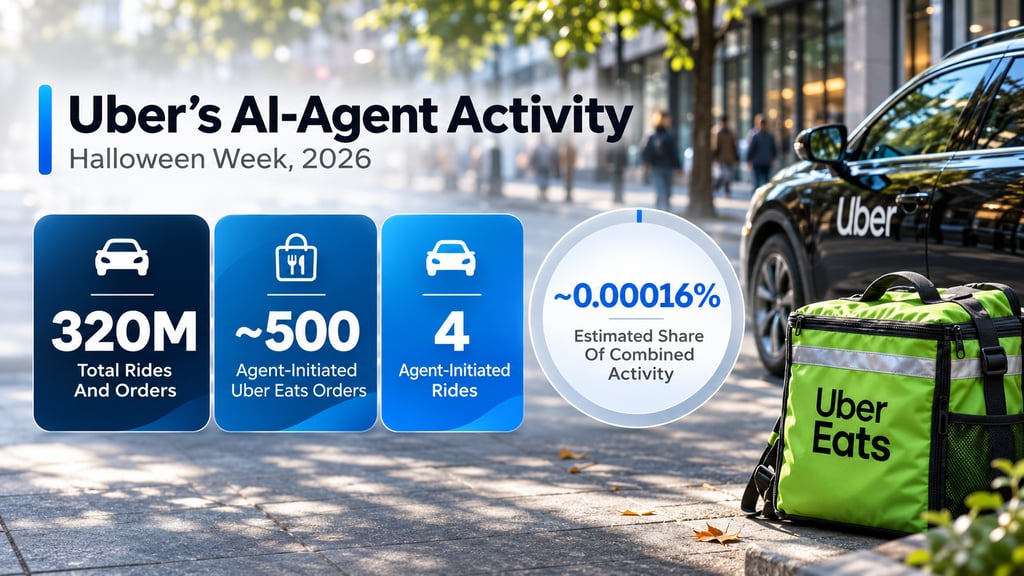
Uber also fulfilled roughly 500 Uber Eats orders initiated by outside AI agents that week, against approximately 320 million combined rides and orders across its platforms. The company disclosed the figures as retailers prepare for more AI-driven shopping and OpenAI expands its business tools in ChatGPT.
For IT and commerce leaders deciding where to invest, the distinction matters: AI that helps customers choose products and AI that initiates purchases need different measures of success.
Uber reports four agent-booked rides and about 500 Eats orders
During Uber’s third-quarter earnings call, CFO Balaji Krishnamurthy revealed that approximately 500 Uber Eats orders and four rides had originated from AI agents during Halloween week.
Using the company’s rounded figures, those 504 transactions represented an estimated 0.00016% of Uber’s combined activity, or roughly one in every 635,000 rides and orders.
The percentage is a calculated comparison, not an official adoption rate. Uber did not disclose separate total transaction volumes for its rides and delivery businesses, so the figures cannot establish an agent adoption rate for either service individually.
CEO Dara Khosrowshahi acknowledged that adoption was still “very, very early” but said Uber would continue working with third-party AI providers, according to Uber’s Nov. 4 earnings-call transcript.
He also pointed to an obstacle facing those providers: Uber’s existing app is already fast. According to Khosrowshahi, booking a ride takes an average of 50 seconds, while reordering a favorite meal takes a median of 90 seconds.
An outside agent would need to offer a meaningful improvement over those experiences to convince consumers to change how they order.
DoorDash is seeing similarly limited agent activity
Uber is not the only delivery company reporting low transaction volumes from external AI agents.
DoorDash CEO Tony Xu said during the company’s third-quarter earnings call that third-party agents had generated only several hundred orders in total since they began operating.
Xu said consumers were still predominantly using DoorDash’s own app for routine orders, although the company was exploring ways to work with external AI providers.
“You never want to fight gravity,” Xu said, according to DoorDash’s earnings-call transcript.
DoorDash’s figure covers cumulative agent activity, while Uber’s numbers refer to one week. The two therefore cannot be used to calculate a direct adoption comparison.
Still, both disclosures suggest that the ability to place orders through an external AI assistant has yet to produce substantial transaction volumes on these platforms.
AI shopping is growing, but what counts as a purchase?
Uber and DoorDash’s figures might suggest that shoppers are reluctant to use AI. Broader research tells a more complicated story.
A McKinsey study, based on a June 2026 survey of approximately 21,000 consumers across 11 markets, found that 53% of adults in a weighted sample had used AI for at least one shopping task during the preceding three months.
Across the surveyed markets, 14% of AI users reported using an AI tool to complete a purchase.
These percentages cannot be compared directly with Uber’s transaction share. McKinsey measured the proportion of respondents reporting particular shopping behaviors, while Uber counted transactions initiated by outside agents on its platforms.
| Shopping activity | What the AI does | Example |
|---|---|---|
| Product discovery | Researches options, compares products, and makes recommendations | ChatGPT shopping tools |
| Assisted shopping | Builds a cart that customers can review before ordering | Uber Eats Cart Assistant |
| Agent-initiated transactions | Initiates orders or bookings on a customer's behalf | External agents placing orders through Uber |
Uber’s own Cart Assistant illustrates the middle category. Customers can enter a shopping request or upload a grocery list, and the assistant creates a draft cart for them to review and edit before placing an order.
The distinction matters for retailers assessing AI adoption. A customer who discovers a product through ChatGPT and completes checkout on a retailer’s website has used AI in the shopping process, but that transaction is different from one initiated by an external AI agent. An agent-initiated transaction may still require customer review or confirmation.
OpenAI’s newest shopping tools emphasize product discovery
On Nov. 10, OpenAI introduced Businesses in ChatGPT, a beta offering that allows eligible businesses to claim profiles and provide updated information through Business Hub.
The company also introduced Business Agents for eligible US e-commerce and online service businesses. These agents can answer customer questions, compare offerings, and help shoppers explore products using information supplied by the business.
Business Hub also provides aggregated insights into how people engage with businesses in ChatGPT, including mentions and website clicks.
The launch follows OpenAI’s March shift toward product discovery, when it said the original Instant Checkout experience lacked the flexibility it wanted to provide and allowed merchants to use their own checkout experiences.
For retailers, the direction offers a potential compromise: AI helps customers find and evaluate products while merchants maintain greater control over the purchase experience.
Access remains another concern. TechRepublic previously reported on Amazon restricting Meta’s Muse shopping agent, illustrating the challenges external agents can face when accessing established retail platforms.
Other companies are developing AI shopping experiences within their own ecosystems. TikTok, for example, introduced an AI shopping assistant alongside its Buy Direct checkout tool, giving eligible businesses another way to connect product discovery with purchases.
What retailers should measure before investing in AI checkout
With more AI shopping tools entering the market, businesses need a way to distinguish promising technology from measurable commercial results.
Three areas deserve attention:
- AI-driven discovery: Track identifiable AI referral visits, product inquiries, and subsequent purchases. Record where attribution is unavailable so untracked visits are not mistaken for an absence of AI influence.
- Completed transactions and costs: Separate external agent-initiated orders from purchases assisted by retailer-operated chatbots. Define each conversion rate’s denominator, such as agent checkout attempts, and compare completion rates, failed orders, refunds, and support costs with the existing checkout. Include integration and operating costs when assessing whether additional sales justify the investment.
- Authorization and customer control: Establish spending limits, approval requirements, and rules for substitutions before allowing agents to purchase. Define who handles cancellations, refunds, and disputed orders. IT teams should document what each agent can access, how access can be revoked, and who owns the transaction audit trail as part of AI agent governance.
A limited pilot should answer a specific business question: Does the agent help customers complete purchases they would otherwise abandon, or does it shift existing orders into a more expensive channel? Compare results with a similar customer group using the existing checkout where feasible.
Uber and DoorDash’s disclosures show limited external-agent transaction volumes on their platforms. They do not establish why usage is low or predict results for every retail category. Retailers should base expansion on their own completion rates, costs, and customer outcomes.
Also read: AI shopping is also making its way into retailers’ own apps. Apple is testing an AI shopping assistant that helps customers with product questions, trade-ins, payments, and orders.