


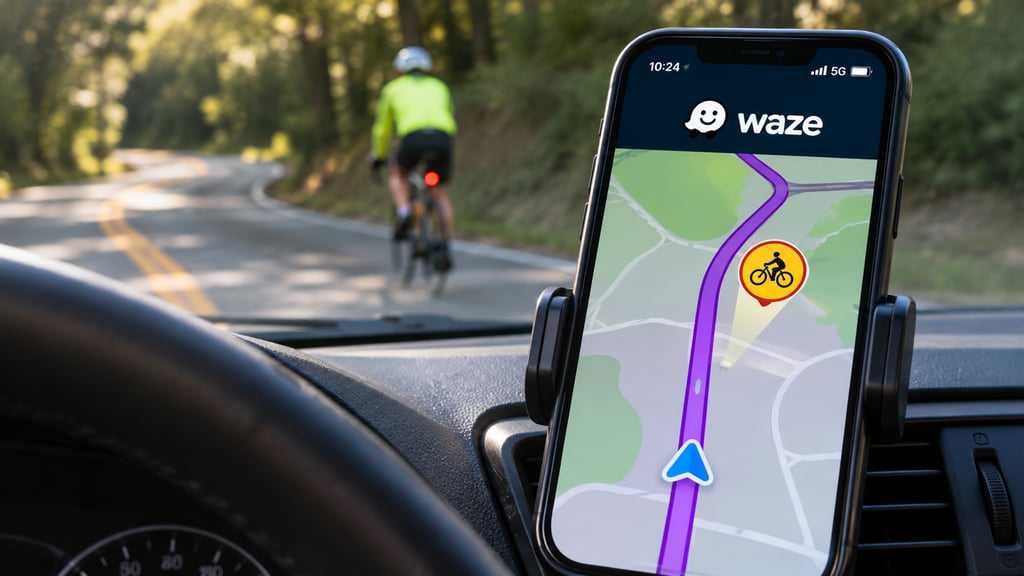
A cyclist could be around the next bend before a driver spots them. Waze now has a way to provide an earlier warning, using live location data from Garmin bike computers and smartwatches.
The two companies launched Live Cycling Alerts on Nov. 10, with a global rollout underway on Android and iOS. When a cyclist enables Garmin LiveTrack and opts in to sharing, nearby Waze drivers can see a moving bicycle icon and receive an alert.
There’s a catch: the system doesn’t detect every cyclist. Waze says the alerts are designed for high-speed and rural roads, not urban streets, and they only work when riders have compatible Garmin devices actively sharing their location.
How Waze and Garmin LiveTrack cyclist alerts work
According to Garmin’s announcement, the integration builds on LiveTrack, a free feature that lets cyclists share their location with friends and family during a ride.
Instead of limiting that information to people with a tracking link, riders can now choose to make their presence visible to nearby Waze users.
To participate, cyclists need:
- A compatible Garmin Edge bike computer or Garmin smartwatch.
- Garmin Connect and an active LiveTrack session for outdoor cycling.
- A one-time opt-in allowing their location to be shared with Waze.
- A working connection to transmit their location.
Most compatible devices use a paired smartphone with cellular coverage. Certain LTE-enabled Garmin devices can run LiveTrack without relying on a phone connection.
Garmin has also expanded LiveTrack connectivity through select premium watches. For example, compatible fēnix 9 Pro configurations offer LTE-powered LiveTrack alongside other connected features.
Once sharing is enabled, cyclists don’t need to repeat the Waze opt-in for every ride. Garmin says sharing begins when they start an eligible LiveTrack activity, whether manually or through automatic activity settings.
Drivers don’t need a Garmin device or subscription.
Waze displays participating cyclists as moving icons and can issue visual and audio warnings when they approach.
The alerts aren’t ordinary crowdsourced reports. Drivers cannot manually report cyclists because the system relies on live location data rather than fixed map markers.
When do drivers receive an alert?
Garmin told Bicycling that notifications generally target drivers traveling on the same road and in the same direction as a participating cyclist.
Drivers may also receive warnings about riders farther ahead on their planned route.
Waze told the publication that drivers don’t need active turn-by-turn navigation. Cyclist icons can appear while the app is open, although the timing and location of alerts depend on the system’s eligibility rules.
When cyclists ride closely together, Waze groups them into one icon to avoid repeated warnings. If the group spreads out, additional icons can appear.
Neither company has disclosed the distance at which an alert is triggered. Drivers therefore shouldn’t assume they’ll receive a warning a specific number of meters before reaching a cyclist.
How to turn cyclist alerts off in Waze
Waze enables cyclist alerts by default, but drivers can adjust them.
According to Waze’s support instructions, the controls are available in the mobile app:
- Open Waze.
- Tap the menu icon and select Settings.
- Choose Alerts and reports, then Reports.
- Select Cyclists.
- Disable Show on map or Alert while driving, depending on which notifications you want to remove.
The first setting controls the map display. The second controls spoken warnings and on-screen alerts.
Drivers using Android Auto or Apple CarPlay should change these settings on their phones. Waze recommends disconnecting the phone from the vehicle’s infotainment system first.
That distinction is useful for anyone who primarily uses navigation through a dashboard. As recent Android Auto connection problems have demonstrated, in-car navigation depends on compatible phone software and a reliable connection.
Where Waze cyclist alerts won’t work
The rollout is global, but that doesn’t mean every road or country is covered.
Waze’s official support page says the feature is designed for high-speed and rural roads where visibility may be limited. Cyclist alerts do not appear in urban areas.
The company also warns that the feature may not be available in every country.
Even on supported roads, a driver will only receive an alert when the cyclist meets the system’s requirements.
That excludes riders who:
- Don’t own a compatible Garmin device.
- Haven’t opted in to Waze location sharing.
- Aren’t running an eligible LiveTrack cycling session.
- Have lost the connection needed to transmit their location.
The alerts also disappear when the cyclist ends the ride.
What information can drivers see?
Waze says the integration does not reveal a cyclist’s name, identity, or exact route.
Drivers receive a temporary notification and a moving icon showing that a participating cyclist is nearby.
The location sharing is session-based, so the cyclist won’t remain visible in Waze after ending the activity on their Garmin device.
Garmin’s standard LiveTrack feature can provide more detailed information, including speed and planned routes, to authorized contacts. Those details are not displayed to Waze drivers through the new integration.
Can Garmin’s alerts actually prevent crashes?
Garmin and Waze say their goal is to help drivers notice cyclists sooner, particularly on roads where visibility is limited.
However, neither company has published crash-reduction data, independent effectiveness testing, or confirmed warning-distance thresholds for the new feature.
The integration also differs from vehicle-to-everything (V2X) technology, which allows equipped vehicles and infrastructure to exchange information directly.
Waze relies instead on consumer devices, Garmin’s LiveTrack service, and a working connection.
Other navigation platforms are developing different forms of driver assistance. Google’s recent Gemini navigation update focuses on conversational route guidance and hands-free requests through Apple CarPlay, rather than sharing cyclists’ live locations.
For drivers, the Garmin partnership adds another possible warning, not a reason to rely less on mirrors, road conditions, or visibility.
For cyclists, opting in may improve their chances of appearing on a participating driver’s screen, but it doesn’t guarantee that approaching vehicles will receive or act on an alert.
A quiet Waze screen should never be interpreted as proof that the road ahead is clear of cyclists.
Also read: Garmin’s fēnix 9 and Forerunner 970 offer different approaches to GPS tracking and outdoor navigation, with the Forerunner geared toward runners and triathletes and the fēnix offering more rugged hardware.