


Key takeaways
-
ClickUp is the overall best project management software: It earned the highest rating for its combination of task management, customizable workflows, and AI capabilities. Asana is a leading option for task coordination, while monday.com excels at visual project tracking.
-
The best platform depends on project complexity: Jira supports Agile software development, Wrike handles high-volume projects, and Smartsheet provides spreadsheet-based planning with advanced reporting capabilities.
-
Pricing depends on the features your team needs: Zoho Projects starts at $4 per user per month, while advanced resource planning, portfolio reporting, and AI automation may require higher-tier subscriptions or additional fees.
(billed annually) |
||
|---|---|---|
- How I evaluated the best project management software
- 1. ClickUp: Best all-in-one AI workspace
- 2. Asana: Best task management
- 3. monday work management: Best for visual project tracking
- 4. Wrike: Best for managing high-volume projects
- 5. Smartsheet: Best for spreadsheet users
- 6. Jira: Best bug & issue tracker
- 7. Zoho Projects: Best for affordability
- 8. Notion: Best personal goal tracker
- Project management software pricing: How much will your team pay?
- Which project management software has the best AI capabilities?
- How to choose the best project management software
- FAQs
How I evaluated the best project management software
To compile this list of the best project management software, I took into account a range of factors, from features and cost to user experience. I conducted testing to better understand each platform’s unique features and gain a firsthand understanding of their functionality, strengths, and weaknesses.
General features (25%): I started with core task management capabilities, such as subtasks, dependencies, and task commenting. I also reviewed reporting tools, dashboards, and the range of project views to see how each platform adapts to different project layouts.
Pricing (20%): I looked at whether each platform offers a free-forever plan or only a time-limited trial. I then compared entry and mid-tier monthly subscription costs, factoring in annual discounts and included features.
Advanced and niche features (20%): I examined resource and capacity planning alongside portfolio management to see how each platform handles multiple projects. I also tested each vendor’s integration with CRMs and video conferencing platforms, along with AI and automation capabilities.
Expert score (15%): I applied a professional assessment based on project performance, overall value, and user popularity. Each platform’s standout capabilities and usability informed the final rating.
Customer service and support (10%): I checked support availability by hours of operation and the range of support channels, including chat and phone. I also reviewed the vendor’s security practices and the depth of their knowledge base.
Ease of use (10%): I considered setup requirements and the technical skill needed to get started. For usability, I checked how users can quickly complete certain tasks such as adjusting workloads, defining task dependencies, configuring task automations, and linking multiple tasks.
Why you can trust TechRepublic
I’ve spent the past four years testing nearly 20 project management platforms, and some of them have become part of my workflow. Writing dozens of PM software guides for businesses of all sizes taught me what individuals and teams need from these tools beyond the marketing pitch. I also build custom scoring rubrics for each review to ensure fairness and that selected platforms get evaluated on the same criteria.
Marianne Sison
Senior Staff Writer for Project Management
1. ClickUp: Best all-in-one AI workspace

My rating: 4.88 out of 5
Why I chose ClickUp
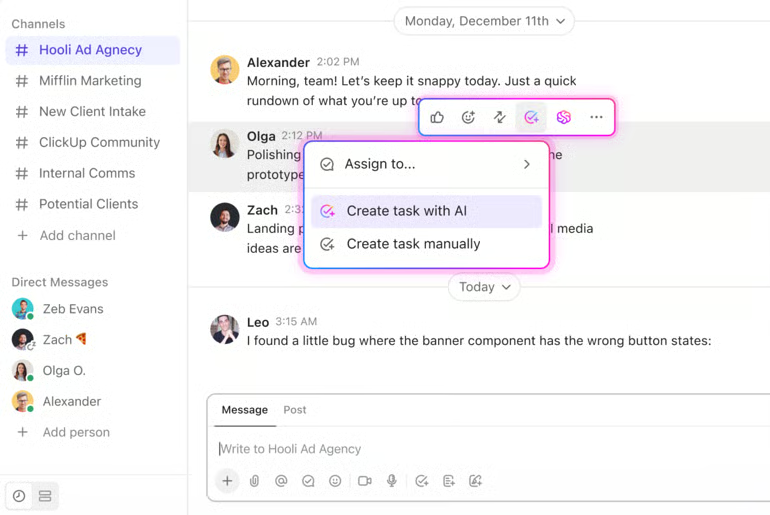
ClickUp earns my top recommendation for tech-savvy teams that want a single AI workspace running across tasks, docs, chat, and calendar. The subscription includes leading chatbot models, including GPT and Claude, and it switches between them based on the request. For teams that manage most of their work in ClickUp, Brain² references workspace activity instead of treating each interaction as a separate session.
Brain² remembers a user’s role and communication preferences, then applies that context to later tasks and conversations. Multiplayer mode adds this context across the teams so that responses can reference shared workspace history. Users can also ask Brain² to create deliverables such as slide decks and dashboards using workspace data.
Advanced AI tools, including Super Agents and AI automations, require ClickUp’s Everything AI plan at $28 per user per month. Additional usage draws from a metered credit pool, which can make AI spending less predictable as adoption increases. In this aspect, Zoho Projects is more affordable, with Zia AI included in paid plans starting at $4 per user per month and no separate metering for standard AI use.
| Pros | Cons |
|---|---|
|
|
Pricing
- Free plan: Includes unlimited tasks and collaborative Docs, with Kanban boards for basic project tracking
- Unlimited: $7/user/month – Adds unlimited storage and Gantt charts, plus time tracking for project control
- Business: $12/user/month – Adds advanced dashboards and workload management with 5,000 monthly automation actions
- Enterprise: Custom pricing – Adds SAML SSO and audit logs, with expanded automation capacity for larger organisations
AI pricing note: Brain AI costs $9/user/month, while Everything AI costs $28/user/month with additional capabilities and credits.
Standout features
- Visualize project schedules through customizable List and Gantt charts.
- Monitor portfolio performance through real-time dashboards with interactive reporting cards.
- Use ClickUp Brain to generate tasks from project documents or team conversations.
- Convert ideas from ClickUp Whiteboards into project tasks.
2. Asana: Best task management

My rating: 4.82 out of 5
Why I chose Asana
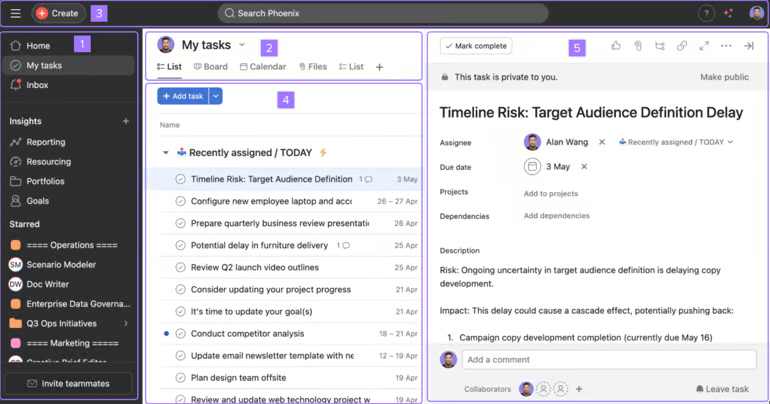
Asana is well suited to teams that want AI embedded in task workflows rather than confined to a separate chat interface. With AI Studio, users can describe what they need in plain language and have Asana create tasks with drafted titles and descriptions, suggest due dates, or prioritize work according to deadlines and blockers.
For automated workflows, AI Teammates can participate in projects alongside employees and accept assigned tasks. AI Studio, on the other hand, handles recurring processes such as status updates and approval routing once the appropriate triggers are configured.
The main consideration with Asana is cost as AI usage increases. AI Studio uses a metered credit pool included with each plan, and teams with heavier automation volumes may need to purchase a higher credit tier after exhausting their allowance.
Smartsheet is a good Asana Alternative that takes a simpler approach to automation costs because unlimited automations are included in the per-user fee, with no additional automation credits required as usage increases.
| Pros | Cons |
|---|---|
|
|
Pricing
- Free plan: Supports two users with unlimited tasks and projects across list or board views
- Starter: $10.99/user/month – Adds Gantt planning and reporting dashboards with unlimited automation rules
- Advanced: $24.99/user/month – Adds portfolios and workload management for projects across departments
- Enterprise: Custom pricing – Adds SAML authentication and capacity planning with central workflow controls
- Enterprise+: Custom pricing – Adds data residency and audit logs for stricter compliance requirements
AI pricing note: AI Studio Basic is included with paid plans
Standout features
- Deploy AI Teammates to complete assigned work within existing project permissions.
- Connect organisational goals to the projects responsible for delivering them.
- Build repeatable processes through visual workflows with conditional logic.
- Review team capacity through workload views before reallocating task assignments.
3. monday work management: Best for visual project tracking

My rating: 4.74 out of 5
Why I chose monday work management
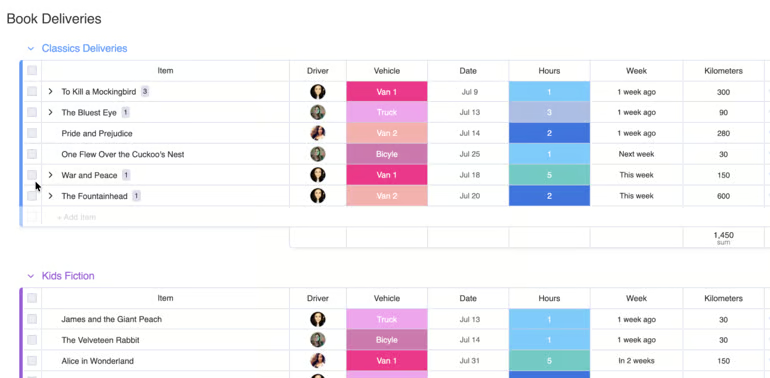
monday work management works well for teams that prefer to monitor projects visually before examining individual task details. A single board can support up to 100 views, with each view presenting the same project data in a different format. For example, a product launch can use a Gantt chart to review the schedule, then switch to Kanban when the team needs to track work by status.
For faster setup, monday’s AI assistant, Sidekick, can create a new view from a plain-language request, although this capability is limited to supported widget types. Once a team settles on a preferred view, the board owner can lock it against edits or pin frequently used views for quicker access. Dashboards support progress reviews by combining project data across multiple boards into a visual summary.
Export options are more restrictive. Only table views can be exported to Excel, and the exported file does not retain settings such as grouping or sorting. Other view types cannot be exported to Excel. Smartsheet handles spreadsheet-based reporting differently because its grid-based project data can be exported to Excel with formatting preserved.
| Pros | Cons |
|---|---|
|
|
Pricing
- Free plan: Includes up to two seats, three boards, and three collaborative documents
- Free trial for paid plans: 14 days for the Pro plan
- Basic: $9/seat/month – Adds unlimited work items and viewers with 1,000 monthly AI credits
- Standard: $12/seat/month – Adds Gantt planning and guest access with 250 monthly automation actions
- Pro: $19/seat/month – Adds private boards and time tracking with 25,000 monthly automation actions
- Enterprise: Custom pricing – Adds portfolio management and advanced permissions with expanded automation capacity
AI pricing note: Paid plans include monthly AI credit allowances. Additional credits are available for purchase.
Standout features
- Consolidate data from multiple boards into executive-level dashboards.
- Automate routine updates through trigger-based recipes without writing code.
- Create specialized AI agents that monitor projects or prepare status reports.
- Collect internal requests through WorkForms that populate connected boards.
4. Wrike: Best for managing high-volume projects

My rating: 4.63 out of 5
Why I chose Wrike
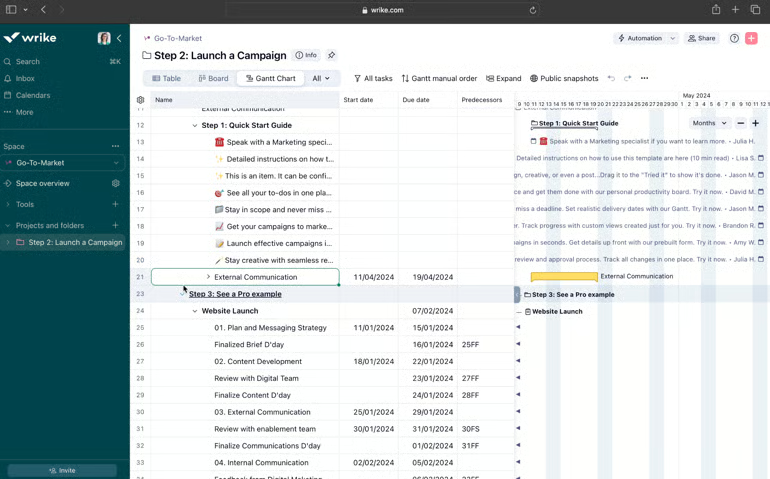
Wrike’s enterprise project platform is ideal for managing a high volume of projects across several teams or clients. With unlimited folders and projects, teams can organize work into tasks and subtasks without changing how they manage projects as volume increases.
To reduce repeat setup, Wrike Blueprints let teams save a project configuration and reuse it whenever the same type of work comes up. For tracking labor-intensive tasks, workload charts show when someone has too much assigned work, which gives managers time to redistribute tasks. Dynamic request forms also help with intake because new requests are sent automatically to the appropriate queue.
Scaling with Wrike can be costly due to the seat-block pricing. The Business plan requires seats to be purchased in blocks of 25, with annual-only billing and no monthly option. Zoho Projects uses a more straightforward per-user pricing, so teams can add seats one at a time as headcount changes.
| Pros | Cons |
|---|---|
|
|
Pricing
- Free plan: Includes task management through board and table views
- Free trial for paid plans: 14 days
- Team: $10/user/month – Adds interactive Gantt charts and shareable dashboards for up to 15 users
- Business: $25/user/month – Adds reusable workflows and AI agent actions for up to 200 users
- Pinnacle: Custom pricing – Adds capacity planning and project budgeting with advanced reporting
- Apex: Custom pricing – Adds higher AI allowances and cross-platform workflow connections
AI pricing note: AI Essentials are included with Team. Business and higher plans include AI Elite actions. Additional AI Elite action packs use custom pricing.
Standout features
- Use Work Intelligence to identify project risks and produce progress summaries.
- Standardize work intake through dynamic request forms with conditional questions.
- Review creative assets through visual markup with version comparison.
- Analyze project performance through interactive business intelligence reports.
5. Smartsheet: Best for spreadsheet users

My rating: 4.58 out of 5
Why I chose Smartsheet
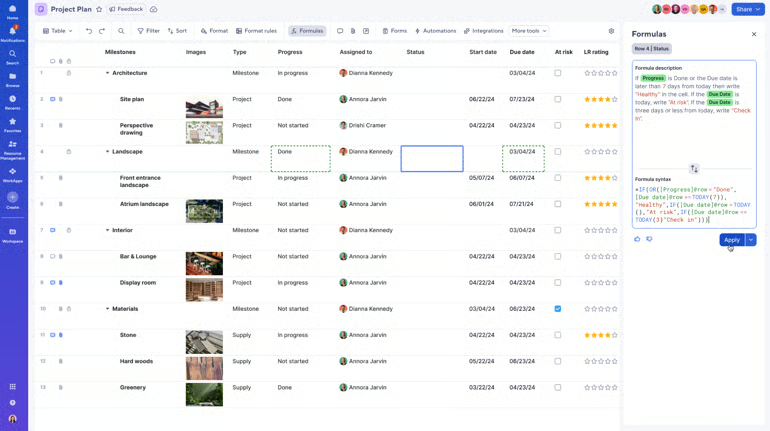
Smartsheet is designed for teams accustomed to working with rows, columns, and spreadsheet formulas. Its formulas use cell references and familiar operators such as + and <, while standard functions such as SUM and AVG work much like they do in Excel. For hierarchical project data, Smartsheet also provides functions such as CHILDREN and ANCESTORS, which reference information across parent and child rows.
For calculations that apply across an entire field, users can create a formula in one cell and convert it into a column formula. Smartsheet then applies the calculation to existing rows and automatically extends it to new ones. Absolute references use a dollar sign to keep a specific cell fixed as the formula carries down the column. Enterprise users can also ask its built-in AI to generate formulas from plain-language instructions.
One thing to note is that formulas must be created and edited within the sheet, while reports and dashboards can only display their results. Certain fields, including Start Date and Predecessors, cannot contain formulas on any plan. Notion handles formulas differently by attaching them to database properties, so the calculation remains available across views that reference the same database.
| Pros | Cons |
|---|---|
|
|
Pricing
- Free plan: Not available
- Free trial for paid plans: 30 days
- Pro: $9/member/month – Adds unlimited sheets and project views with 250 monthly automation actions
- Business: $19/member/month – Adds workload tracking and administrative controls with unlimited automations
- Enterprise: Custom pricing – Adds portfolio management and SAML SSO with central plan administration
- Advanced Work Management: Custom pricing – Adds portfolio provisioning and controlled data sharing across business systems
AI pricing note: Conversational AI capabilities are included from the Pro plan.
Standout features
- Manage project data through a spreadsheet-style interface with cell-level formulas.
- Switch to Gantt view to examine dependencies and identify the critical path.
- Ask Smart Assist to summarize project health or recommend follow-up actions.
- Generate stakeholder dashboards from project data through natural-language prompts.
6. Jira: Best bug & issue tracker

My rating: 4.43 out of 5
Why I chose Jira
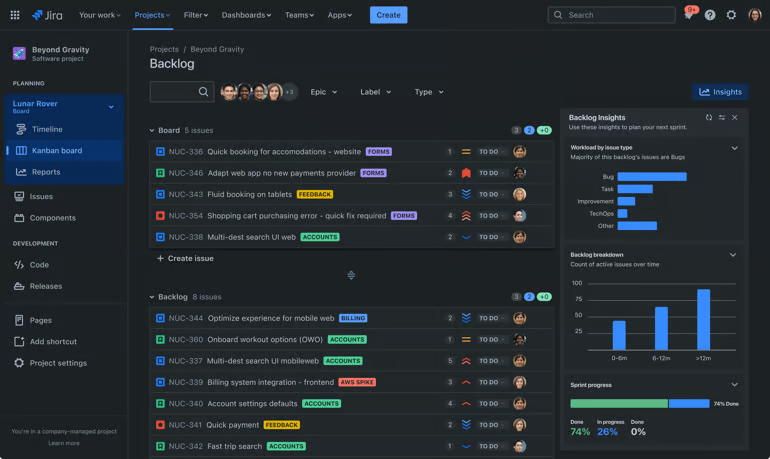
Jira is well suited to engineering teams that need bug reports for recording diagnostic information, such as severity and affected version, alongside steps for reproducing the issue. Each work item type can also follow its own custom workflow, so bugs can move through a different set of statuses than feature requests within the same project.
Once a bug enters the backlog, teams can drag it into the to-do queue when it is ready for development. Automation rules can handle the initial assignment based on a component or label, and Jira provides a prebuilt rule template for this process. Development activity can then remain connected to the original ticket. For example, a developer can create a Bitbucket branch from Jira, while the ticket reflects progress as the code moves through pull request, merge, and deployment.
However, automation limits become more restrictive as rule volume increases. Jira Standard includes 1,700 rule executions per month across the site, while Premium increases the allowance to 1,000 executions per paid user each month. Zoho Projects provides a larger automation allowance at a comparable price point, with 50,000 monthly credits on Enterprise and 500,000 on Ultimate.
| Pros | Cons |
|---|---|
|
|
Pricing
- Free: Up to 10 users — Includes reports, dashboards, unlimited projects, forms, 2GB storage, and project views (backlog, list, board, timeline, and summary)
- Standard: $9.05/user/month — Adds AI assistant, user roles, external collaboration, 250GB storage, and 1700 automation rule runs
- Premium: $18.30/user/month — Adds dependencies, custom approvals, unlimited storage, and 1,000 rule runs per user
- Enterprise: Custom — Adds advanced admin controls and security, cross-product insights, and unlimited automation rule runs
AI pricing note: Rovo and Jira’s integrated AI capabilities are included with Standard and higher plans.
Standout features
- Set up Scrum boards based on software issue types
- Automate issue transitions through rules based on project events.
- Use Rovo agents to search project information or support automated workflows.
- Evaluate sprint performance with agile reports that show real-time project data.
7. Zoho Projects: Best for affordability

My rating: 4.13 out of 5
Why I chose Zoho Projects
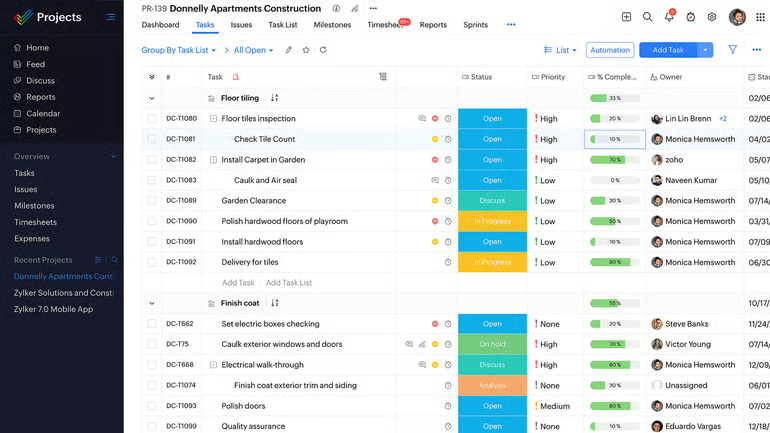
Zoho Projects stands out for its low entry cost, especially for smaller teams with limited budget. Its free plan supports five users and three projects with 5GB of storage, while paid plans start at $4 per user per month. Compared with many competing platforms, teams can move to a paid plan without a substantial jump in per-user costs.
At $4 per user per month, Premium includes unlimited projects and timesheets, plus workload reporting and Zia AI features. Organizations that need strict admin controls can move to Enterprise for $9 per user, which adds SSO, two-factor authentication, and custom domains. Automation allowances vary by tier, however, with monthly limits ranging from 5,000 actions on Premium to 500,000 on Ultimate. Teams that expect frequent automated workflows should estimate their usage before selecting a plan.
Some project controls require a higher subscription. Critical path analysis, baselines, and custom fields become available on Enterprise and above, while more extensive reporting also requires an upgrade. For teams that prioritize resource management at a similar price point, ClickUp Unlimited includes native time tracking and custom automations.
| Pros | Cons |
|---|---|
|
|
Pricing
- Free plan: Supports five users and three projects with 50 monthly workflow executions
- Free trial for paid plans: 15 days
- Premium: $4/user/month – Adds unlimited projects and timesheets with 5,000 monthly workflow executions
- Enterprise: $9/user/month – Adds portfolio reporting and project baselines with 50,000 monthly workflow executions
- Ultimate: $14/user/month – Adds resource management and custom dashboards with 500,000 monthly workflow executions
AI pricing note: Zia capabilities are included with Premium and higher plans. The Free plan includes Zoho MCP Server access.
Standout features
- Design task processes through the drag-and-drop Blueprint editor.
- Use Zia to summarize discussions or generate tasks from project context.
- Record billable hours through time logs with approval workflows.
- Monitor project health through portfolio dashboards with budget reporting.
8. Notion: Best personal goal tracker

My rating: 3.98 out of 5
Why I chose Notion
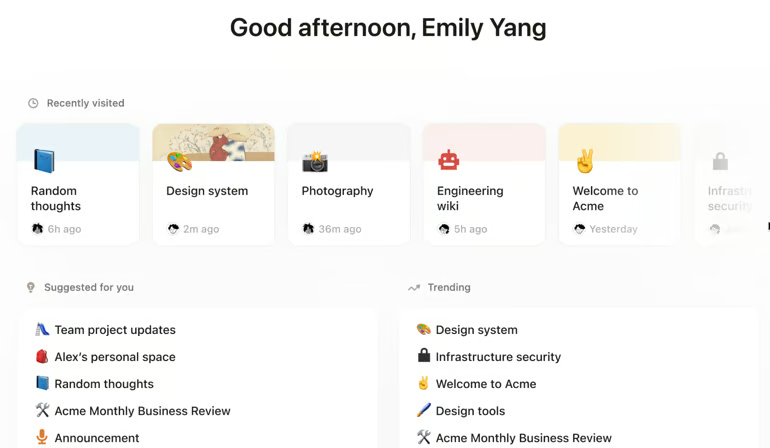
Notion works well for individual goal tracking because you can build a dashboard based on how you organize your work. For simple goals, basic to-do blocks may be enough. If you need deadlines, subtasks, or priority sorting, a database gives you more control. Properties such as Status, Date, and Select let you track progress and categorize goals without forcing you into a fixed template.
What gives Notion more appeal for solo users is the amount of context you can add into the same dashboard. Linked databases can surface company or team objectives alongside your own goals, so you can see how your work connects to broader priorities. Link previews can also pull updates from third-party tools such as Jira, Asana, or GitHub.
The downside is that Notion does not provide native progress bars for goals, OKR scoring, or automated check-in reminders. You have to build and maintain those elements yourself. monday.com may be a better choice if you want dedicated goal tracking with automatic progress percentages and milestone tracking already built in.
| Pros | Cons |
|---|---|
|
|
Pricing
- Free plan: Includes unlimited pages for individuals with basic task databases and 10 guests
- Plus: $10/member/month – Adds unlimited file uploads and database automations with custom forms
- Business: $20/member/month – Adds Notion Agent and AI Meeting Notes with SAML SSO
- Enterprise: Custom pricing – Adds SCIM provisioning and audit logs with zero AI data retention
AI pricing note: Notion’s main AI capabilities are included with Business and Enterprise. Free and Plus receive limited trials. Custom Agents cost $10 per 1,000 monthly Notion credits.
Standout features
- Manage project work through databases with configurable properties and relational records.
- Use Notion Agent to create or update project pages from workspace context.
- Automate recurring processes through Custom Agents that operate on a schedule.
- Search workspace content and connected applications through Enterprise Search.
Project management software pricing: How much will your team pay?
Project management software can cost from $1,200 to more than $30,000 annually for teams of 25 to 100 users, depending on the platform and required features. Entry-level plans often cover task management and scheduling, while advanced resource planning or enterprise security may require more expensive subscriptions.
The table estimates annual subscription costs based on the lowest-priced plans that meet the requirements of each scenario.
- 25 users: Editing access, task dependencies, Gantt planning and basic reporting.
- 100 users: Editing access, workload reporting and centralized administration.
- 250 users: Portfolio reporting, resource capacity planning and enterprise identity controls.
| 25 users | 100 users | |
|---|---|---|
| ClickUp | $2,100 (Unlimited) | $14,400 (Business) |
| Asana | $3,297 (Starter) | $29,988 (Advanced) |
| monday.com | $3,600 (Standard)* | $22,800 (Pro)* |
| Wrike | $7,500 (Business) | $30,000 (Business) |
| Smartsheet | $5,700 (Business) | $22,800 (Business) |
| Jira | ~$2,373 (Standard) | ~$17,448 (Premium) |
| Zoho Projects | $1,200 (Premium) | $10,800 (Enterprise) |
*Based on published per-seat rates. monday.com may require purchasing seats in predefined increments, so actual charges may be higher.
For organizations with 250 or more users, most providers require custom enterprise quotes to meet advanced portfolio management, resource planning and security requirements. These costs are excluded from the table because publicly listed prices do not reflect the required enterprise capabilities.
Which project management software has the best AI capabilities?
ClickUp, Asana, and monday.com are among the leading options for AI-powered project management, although each emphasizes different workflows. ClickUp offers AI assistants and agents for project updates and task automation. Asana supports AI-driven workflows through AI Studio, while monday.com provides AI agents and workflow automation. The best choice depends on which tasks AI can complete and how much repeated usage costs.
Compare AI capabilities by the work they perform
AI features range from generating project summaries to executing workflow actions. When comparing platforms, use the same project data to test these five capabilities:
| AI capability | What to test |
|---|---|
| Project planning | Can AI convert a project brief into tasks with owners, deadlines, and dependencies? |
| Status reporting | Can it identify overdue milestones and explain schedule changes using current project data? |
| Risk identification | Can it detect conflicting assignments or potential delays before deadlines are missed? |
| Workflow automation | Can it assign tasks or update statuses automatically based on defined conditions? |
| Workspace search | Can it retrieve accurate project information from connected applications? |
Understand what AI can automate
AI can generate project plans, summarize progress, and perform supported workflow actions. However, its capabilities depend on the project data it can access and the permissions granted to it.
Test the difference between recommendations and execution. For example, if a milestone slips by three days, determine whether AI merely recommends a revised schedule or can update affected tasks and notify their owners. Verify whether those changes require approval and whether the system records them.
Calculate AI costs based on usage
AI pricing varies considerably between providers:
- ClickUp: Brain AI offers per-user subscriptions, while premium agent capabilities may consume additional AI credits.
- Asana: Paid plans include AI Studio allowances, with additional credits available for purchase.
- monday.com: Its AI work platform uses credits for supported AI features, including agents and AI-powered workflows.
- Jira: Paid cloud plans include Rovo credit allowances for eligible AI capabilities, with usage limits determined by the subscription.
Buying tip: Estimate the number of AI actions your team will use monthly. For example, 20 project managers generating five reports each week would require approximately 400 reports per four-week period. Check whether the selected plan covers that volume and what happens when usage limits are reached.
How to choose the best project management software
Choose project management software based on the capabilities your team requires, how well the platform handles project work and the total subscription cost. Use these five steps to compare shortlisted options before purchasing.
1. Identify your project requirements
Determine which features are essential and which subscription plans include them.
- Scheduling: Do you need task dependencies, automatic rescheduling or critical path analysis?
- Resource management: Do managers need to monitor employee capacity across multiple projects?
- User access: How many employees need editing permissions versus read-only access?
2. Test the same project in each platform
Use a 14-day free trial, where available, to compare two or three shortlisted tools. Create an identical project with dependencies, resource assignments and reporting requirements.
Run a delay test: Move a critical task’s deadline by three days. Check whether dependent dates shift, resource conflicts become visible and affected team members receive notifications.
3. Verify integrations and data portability
Confirm whether the software exchanges information reliably with your existing applications.
- Integrations: Check whether updates sync in both directions, how frequently they sync and how conflicting changes are handled.
- Data exports: Export a completed project and check whether dependencies, custom fields and attachments are preserved.
4. Check security and administration requirements
For mid-size and enterprise teams, verify:
- Access controls: Single sign-on (SSO), automated user provisioning and role-based permissions.
- Data residency: Available hosting regions and applicable compliance requirements.
- Employee offboarding: Whether administrators can revoke access and transfer project ownership.
5. Calculate the full annual cost
Compare the lowest subscription tier that meets your requirements rather than advertised starting prices. Account for:
- Licensing: Paid editor seats, minimum seat commitments and projected user growth.
- Additional charges: AI credits, automation limits and premium features.
Cost check: Calculate expenses for your current headcount and projected headcount in 12 months. This identifies when a lower-priced plan becomes more expensive as your team’s requirements increase.
FAQs
What is the best project management software?
ClickUp is the top-recommended project management software for teams that want task planning, documentation and AI capabilities in one workspace. monday.com is better suited to visual project tracking, while Asana offers workflow automation and task coordination. The best option depends on project complexity and the capabilities included in each subscription tier.
How much does project management software cost?
Project management software typically starts at $4 to $12 per user per month with annual billing. Organizations should calculate costs using the minimum subscription tier that provides their required capabilities. Check seat minimums and usage allowances because AI credits or add-ons can increase the final cost.
What is the easiest project management software to use?
monday.com is one of the more accessible project management platforms for teams that prefer visual workflows. Its grid-style boards provide configurable views for tracking tasks and project progress. However, setting up advanced automations or managing several connected boards can require additional training. Asana is another option for teams that prefer a more standardized task interface.
What is the difference between task management and project management software?
Task management software focuses on individual assignments, ownership and completion status. Project management software also supports scheduling dependencies, resource allocation and reporting across related work. A task management platform may be sufficient for recurring work, while projects involving shared resources or interdependent deadlines generally require more extensive project tools.