


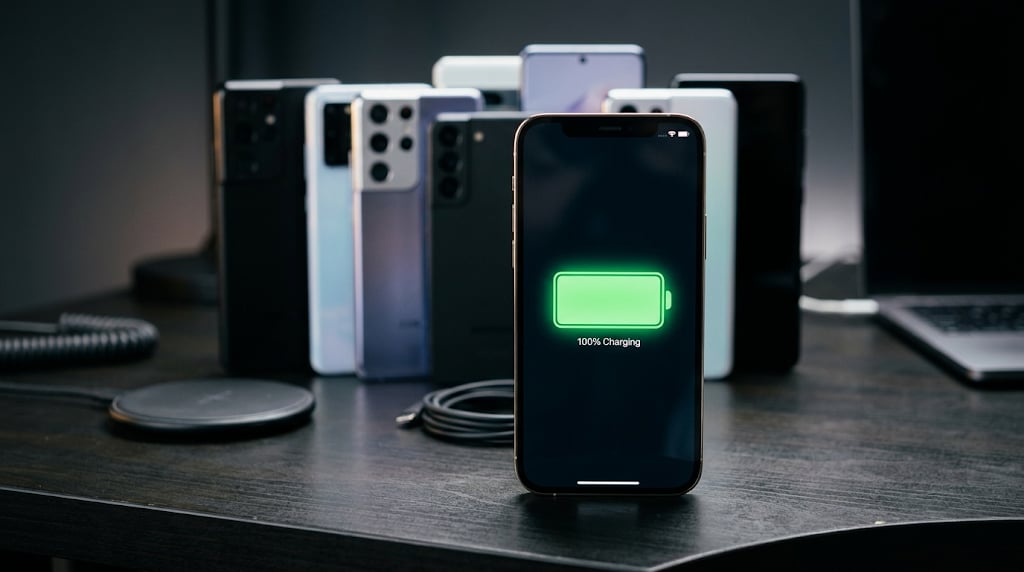
Apple’s biggest iPhone has topped a major battery test. The surprise is how closely some much cheaper phones kept up.
The iPhone 18 Pro Max finished first overall in a battery comparison involving 32 smartphones conducted by CNET, outperforming devices from Apple, Google, Motorola, OnePlus, and other manufacturers. The findings, published in CNET’s Nov. 3 report, also revealed impressive performances from older and more affordable models.
For anyone considering a smartphone upgrade, the results raise an important question: How much should you actually spend to get excellent battery life?
- Which smartphones performed best in the battery test?
- How CNET tested battery life across 32 phones
- Why the iPhone 18 Pro Max performed so well
- Cheaper smartphones delivered some of the biggest surprises
- Smartphone battery life hasn’t improved as much as expected
- Is the iPhone 18 Pro Max worth buying for battery life?
Which smartphones performed best in the battery test?
The iPhone 18 Pro Max claimed the highest overall ranking, although several other devices stood out in CNET’s individual tests. The results also showed that price and battery performance don’t always move together.
| Smartphone | Battery-test result | Why it stands out |
|---|---|---|
| iPhone 18 Pro Max | First overall; 99% remaining in mixed-use test | Best combined performance |
| iPhone 18 Pro | Tied for second overall; 94% remaining after three hours of streaming | Best streaming result |
| iPhone 17 | Tied for second overall | Stronger-value Apple alternative |
| OnePlus 15 | Tied for second overall | Competitive Android flagship |
| iPhone Duo | Tied for fourth overall; 99% remaining in mixed-use test | Strong result for a foldable |
| Google Pixel 11 Pro XL | 97% remaining in mixed-use test | Strong mixed-use performance |
| Motorola Moto G Stylus (2026) | Ranked among CNET's top 10 | Competitive budget option |
| Motorola Edge (2026) | Ranked among CNET's top 10 | Strong midrange performance |
Source: CNET battery testing. Percentages represent battery charge remaining after the specified test. CNET’s rankings include ties, so more than 10 phones can occupy the top 10 ranking positions.
One particularly interesting result involved Apple’s foldable iPhone Duo. Although the $1,999 device tied for first in the mixed-use test, it tied for fourth overall with the $699 iPhone 17e and $1,400 Motorola Razr Ultra (2026). That put Apple’s less expensive iPhone 17e on equal footing with two foldables costing substantially more, underscoring how little price alone can tell buyers about battery endurance.
How CNET tested battery life across 32 phones
CNET published its comparison on November 3 after testing 28 smartphones in 2026 and including four additional handsets that the publication said hadn’t received updates that year. Each of the 32 smartphones underwent three hours and 45 minutes of standardized testing, equivalent to 120 hours of combined battery testing.
The testing included:
- Three-hour video-streaming test: Each phone streamed video over Wi-Fi with its display set to maximum brightness.
- 45-minute mixed-use test: Devices performed activities including video playback, video calls, gaming, and social media use.
- Combined scoring: CNET averaged the remaining battery percentages from both tests to determine the overall rankings.
Both tests began with fully charged batteries. Because the rankings combined two different workloads, the overall winner wasn’t necessarily the strongest performer in each individual category.
For example, the smaller iPhone 18 Pro delivered the best streaming result, retaining 94% of its charge, while the Pro Max finished first overall. Those differences matter because battery life depends heavily on how a phone is used. Someone who spends hours watching videos may experience different results from someone who frequently uses navigation, video conferencing, or demanding applications.
The tests provide a standardized comparison of battery performance, although real-world endurance will vary depending on screen brightness, network conditions, applications, and individual usage patterns.
Why the iPhone 18 Pro Max performed so well
The iPhone 18 Pro Max combines a larger battery with Apple’s A20 Pro processor and iOS 27. Those improvements may help explain its strong performance, although CNET’s tests did not isolate how much each component contributed.
The battery increase is particularly significant. According to iFixit teardown reporting, the following capacities apply to US eSIM-only models:
- iPhone 18 Pro Max: 5,567mAh, compared with 5,088mAh in the iPhone 17 Pro Max, an increase of approximately 9.4%.
- iPhone 18 Pro: 4,288mAh, compared with 4,252mAh in the iPhone 17 Pro, an increase of approximately 0.8%.
Versions sold in markets where physical SIM trays are available may have different capacities. Regardless of configuration, battery size is only part of the equation. Display efficiency, processor demands, connectivity, and software behavior also influence power consumption, helping explain why phones with similar battery capacities can deliver noticeably different results.
According to Apple’s official specifications, the iPhone 18 Pro Max supports up to 45 hours of video playback and 40 hours of streamed video playback under Apple’s testing conditions. Those estimates use a different methodology from CNET’s independent tests and aren’t directly comparable.
For more details about Apple’s hardware, charging capabilities, and the differences between its two Pro models, see TechRepublic’s iPhone 18 Pro cheat sheet.
Cheaper smartphones delivered some of the biggest surprises
The iPhone 17 and iPhone 17e stood out among the more affordable Apple options, while Motorola demonstrated that lower-cost Android phones can compete with premium devices.
The iPhone 17 tied for second overall alongside the iPhone 18 Pro, OnePlus 15, and Motorola Razr (2026), despite substantial differences in battery capacity and pricing among those models. Meanwhile, the $500 Motorola Moto G Stylus (2026) and $600 Motorola Edge (2026) both ranked among CNET’s top 10, putting them in the same performance conversation as much more expensive smartphones.
CNET identified the iPhone 17 as one of its stronger battery-value options, making it worth considering for buyers who don’t need every feature offered by Apple’s Pro models.
TechRepublic previously examined five iPhone 18 Pro alternatives under $1,000, including the iPhone 17, OnePlus 15, Samsung Galaxy S26, Google Pixel 11, and Samsung Galaxy S26 FE. While battery life is only one consideration, CNET’s findings offer another reason to compare independent performance results before paying for a flagship upgrade.
Smartphone battery life hasn’t improved as much as expected
Despite the Pro Max’s strong showing, CNET found that average battery performance among the phones tested in 2026 was approximately unchanged from the results recorded in 2025 and 2024. The finding suggests that improvements in battery capacity and processor efficiency haven’t consistently translated into longer endurance across the publication’s test samples.
One possible explanation is that newer devices are also becoming more demanding. Brighter displays, faster processors, advanced cameras, and increasingly sophisticated software features can consume some of the additional energy provided by larger batteries.
CNET’s manufacturer-level comparison offered a brighter result for Apple, which finished first in average battery performance for the second consecutive year, followed by OnePlus. The manufacturer comparison covered brands with multiple phones in CNET’s testing sample, so the results shouldn’t be interpreted as a ranking of every smartphone on the market.
CNET also highlighted silicon-carbon batteries, including those in Samsung’s Galaxy Z Fold 8 and Motorola’s Razr (2026), as a technology that can increase battery capacity without requiring a proportionally larger battery. While the technology offers potential advantages for smartphone endurance, actual battery life still depends on the device’s hardware, software, and usage conditions.
Is the iPhone 18 Pro Max worth buying for battery life?
If endurance is the top priority and budget is less of a concern, the iPhone 18 Pro Max makes a compelling case. Its first-place finish demonstrates strong performance under CNET’s testing conditions, although the comparison doesn’t establish exactly how much longer it would last than competing phones during a typical workday.
Before upgrading, buyers should consider three factors:
- Battery needs: Heavy users may benefit more from the Pro Max’s additional endurance, while occasional users may be satisfied with less expensive devices.
- Overall value: The iPhone 17 and several Android alternatives delivered competitive results without the highest flagship prices.
- Long-term ownership: Software support, security updates, device-management compatibility, and battery replacement costs can matter as much as initial performance.
For businesses purchasing smartphones for employees, those considerations become particularly important. Small differences in purchase prices can add up across large deployments, while employees who rely heavily on navigation, video calls, and mobile productivity tools may benefit from longer endurance.
TechRepublic’s iPhone 18 Pro vs. Pixel 11 Pro comparison examines broader trade-offs, including software support and charging.
Ultimately, CNET’s findings establish the iPhone 18 Pro Max as the strongest overall performer in its comparison, but they also demonstrate that competitive battery endurance is available at substantially lower prices. For buyers weighing an upgrade, the more useful question may be whether the additional endurance justifies the cost.
Related reading: For a closer look at why bigger batteries don’t always deliver longer endurance, see TechRepublic’s comparison of 10 smartphones with the largest batteries, including models with capacities approaching 10,000mAh.